
Last Updated on November 20, 2026
We had never played at Knockout Escape Rooms before, but when we planned a day of escape rooms in Reading, two of their games kept coming up as recommendations: The Locktopus and Dirty Money. So we booked both for the same day in November 2026 and played as a team of four.
Knockout is about a 16-minute walk from Reading Station, tucked away on an industrial estate. Inside, it’s like most escape room venues: plenty of space to sit and wait, lockers for your things and water if you need it.
We actually played Dirty Money first. Our game master told us The Locktopus is a complex game and suggested we warm up with Dirty Money, an easier and more traditional room. Good advice, as it turned out.
Table of Contents
The Locktopus Ratings
| Category | Score (out of 5) |
|---|---|
| Overall | 5 |
| Immersion and set | 4 |
| Puzzles | 5 |
| Game master and clues | 5 |
| Story and theme | 4 |
The Briefing and Story
The story is simple: a rogue AI calling itself the Locktopus has invited you into its chamber of challenges, and you have one hour to impress it.
The briefing, on the other hand, was long, because this game works very differently from a normal escape room. Our game master explained it like this:
- There are 74 puzzles split across 8 strands, like the arms of an octopus.
- At the start only one strand is unlocked. Solve a few puzzles in it and the other strands open up.
- The aim isn’t just to escape, it’s to get the highest score. Each puzzle is worth 150 or 300 points, but you don’t know which while you’re solving it.
- Points are deducted for every second that passes until you escape. Once you’re out, the clock stops eating your score, and any extra puzzles you solve add to your total.
- Plenty of puzzles don’t move you towards the exit at all. They’re there for points.
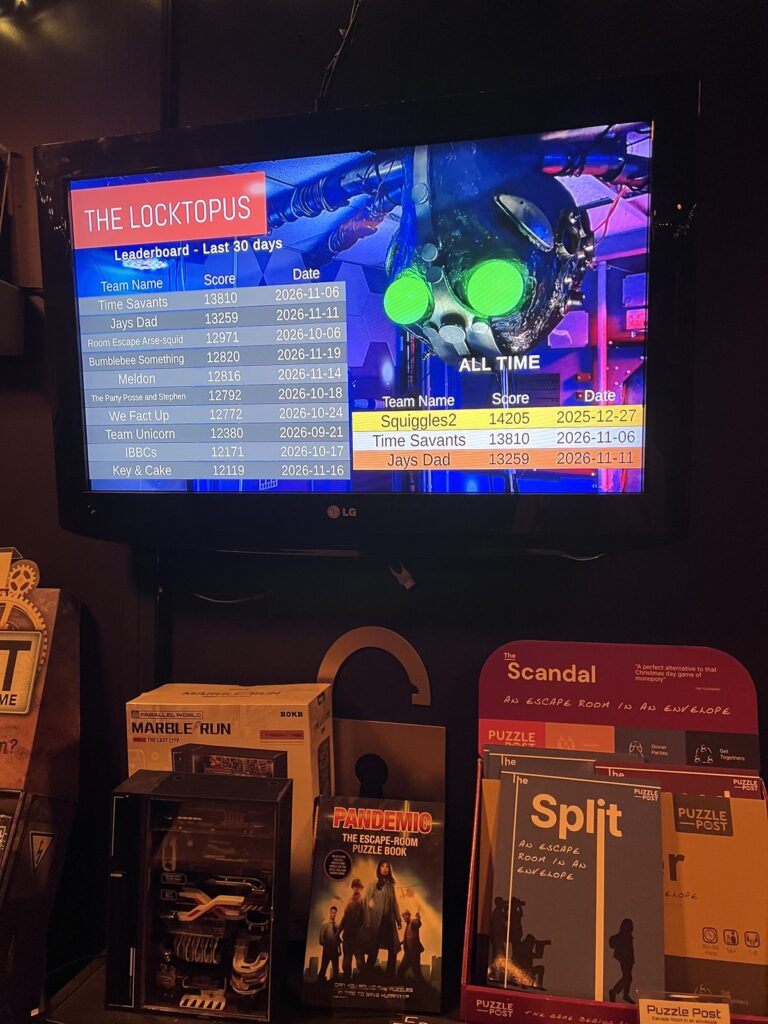
The all-time record is 14,205. When we visited, the best score of the previous 30 days was 13,810.
Clues are available at any point, but we asked for none. Because the game is non-linear, a screen in the room tells you what to do next on the main strand, so you don’t lose track of the route to the exit.
Immersion and Room Design
The room has a sci-fi, techy look, and the centrepiece is a massive touch screen table in the middle. Most puzzles are answered by entering a code or something similar into that table.
The table was very easy to use, but there’s only one of it, so you have to take turns. That adds to the challenge when four people have answers ready at once.
There are no padlocks anywhere. Everything is solved through the screen or by pressing things around the room, and there are lots of hidden items to find.
One thing that sets The Locktopus apart from most escape rooms: you can use things more than once. Nothing is discarded after you’ve used it, which makes the room much more complex, as any object could still matter later.
The set does the job, but this isn’t a game you play for immersion. It’s a game you play for the puzzles.
Puzzles
The puzzles are where The Locktopus shines. They were original and made clever use of the screen, even if they weren’t especially immersive.
I’d say around 70% were logic puzzles, with some maths thrown in. A minority had a physical element, like arranging things, and a few needed you to use all your senses, which was a nice touch. Mostly, though, it was brainwork, or pressing buttons and then brainwork.
Difficulty varied a lot. Some puzzles were very easy, while others were really hard and took several steps to crack.
The point deductions didn’t make us rush. The bigger challenge was focus: with 74 puzzles on offer, it’s very easy to get overwhelmed or sidetracked. Our plan was to stick to the main strand and escape early, then mop up extra puzzles for points. Instead we kept getting distracted by side puzzles and escaped at around 55 minutes, leaving only 5 minutes to boost our score.
We split up for a lot of it. Some puzzles were solo jobs, others needed teamwork, and the shared table meant regular turn-taking.
Game Master and Clues
Our game master was Ash, and he was excellent. He was enthusiastic, clearly fascinated by the mechanics of the game, and he explained the complicated format really well. We played four escape games that day, and Ash was the best game master of the lot.
We got through the whole game with no clues. The on-screen guidance did help keep us on the main strand, though, so it’s a good safety net.
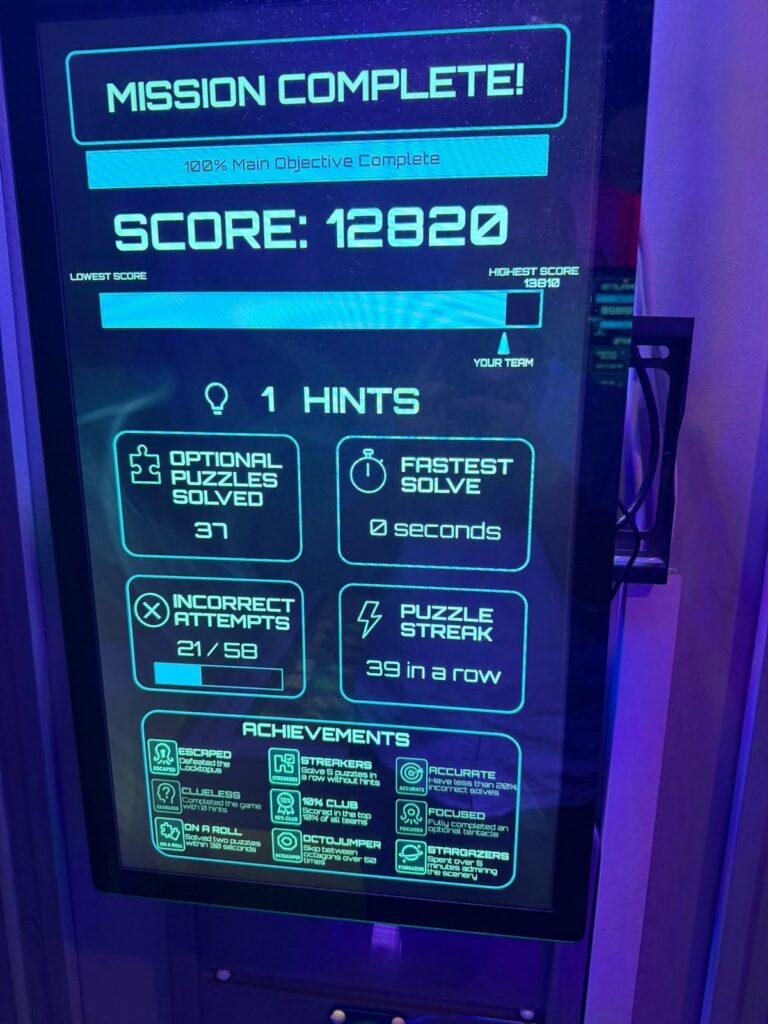
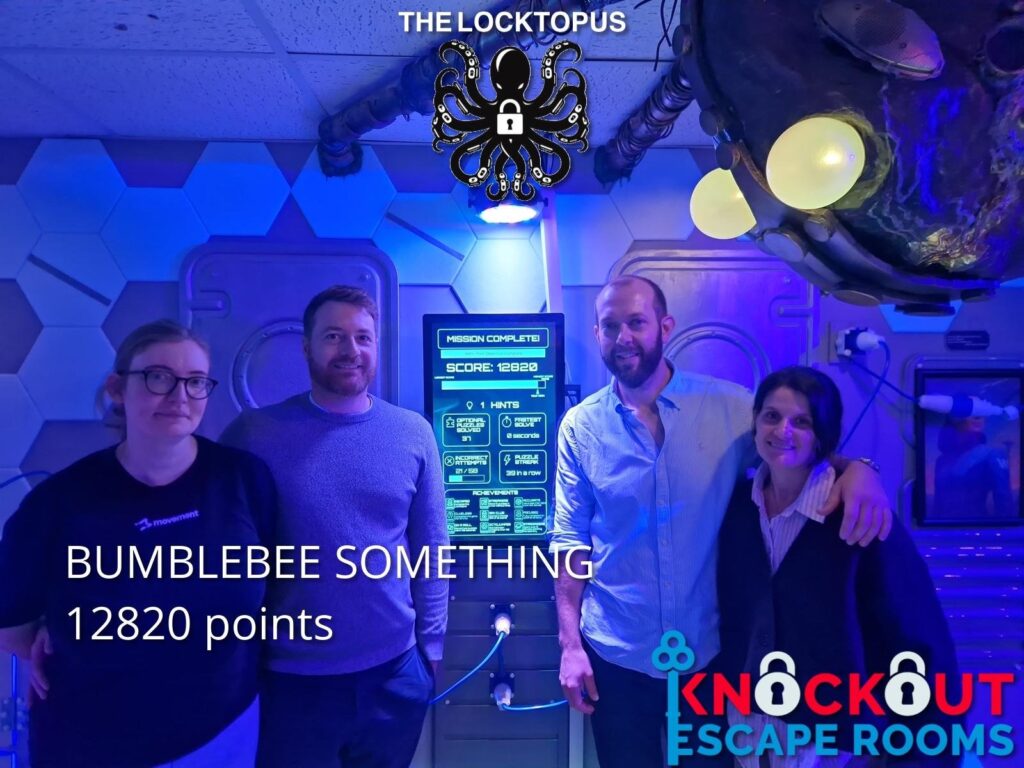
At the end, Ash pulled up all 74 puzzles on the screen and showed us which ones we had completed: 39 out of 74. Our final score was 12,820, which put our team, Bumblebee Something, fourth on the leaderboard for the last 30 days. That’s above average, but we left a little disappointed, as we felt we could have done more.
Verdict
The Locktopus is a fantastic game and one of the most original rooms we’ve played. With 74 puzzles, a completely non-linear structure and objects you can reuse, there’s nothing else quite like it.
It’s definitely not one for beginners, who would likely find it overwhelming. Start with Dirty Money instead. For experienced players, though, it’s a wonderful room that everyone should try. Bring a bigger team if you can, as there’s far more to do than any team can finish in an hour.
The Locktopus only opened in late 2025, so it hasn’t had a chance to feature in TERPECA yet. TERPECA is the escape room world’s big enthusiast award, voted on by players who have each played at least 200 rooms. The 2026 results are due in December, and we’ll be watching out for it.
We’re already thinking about going back to tackle more of the puzzles and beat our score. At £25 per person, with this many puzzles to solve, it’s great value for money.
Practical Info
- Location: Knockout Escape Rooms, 75 Milford Road, Reading RG1 8LG, about a 16-minute walk from Reading Station, up a flight of stairs
- Price: we paid £25 per person as a team of four
- Players: up to 6 (we played as four)
- Length: 60 minutes
- Ages: Knockout’s FAQ says the minimum age is 10, with a parent. Some listings say 12, so check when you book
- Book: Book The Locktopus on the Knockout site.
If anyone in your team is colour-blind, ask the game master to switch on the colour-blind mode. Some items are labelled too.
Enjoyed this article? Support my work by buying me a latte. Otherwise, do me a great favor of leaving a comment and following me on Instagram (@travelwithpau). Feel free to say ‘Hello!’ I don’t bite. And make sure you save the article for later on Pinterest!

This post contains affiliate links. If you click on one and make a purchase, I might make a small commission, at no extra cost to you in order to help support my blog.


