
Visiting Victoria Falls: The Complete Travel Guide
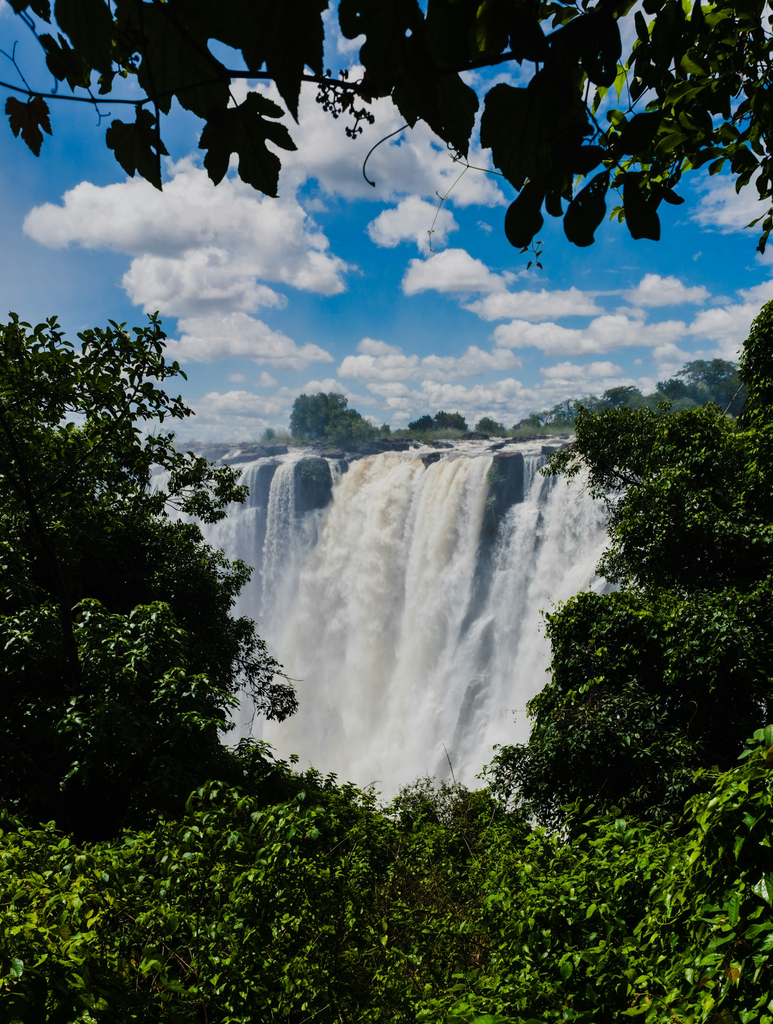
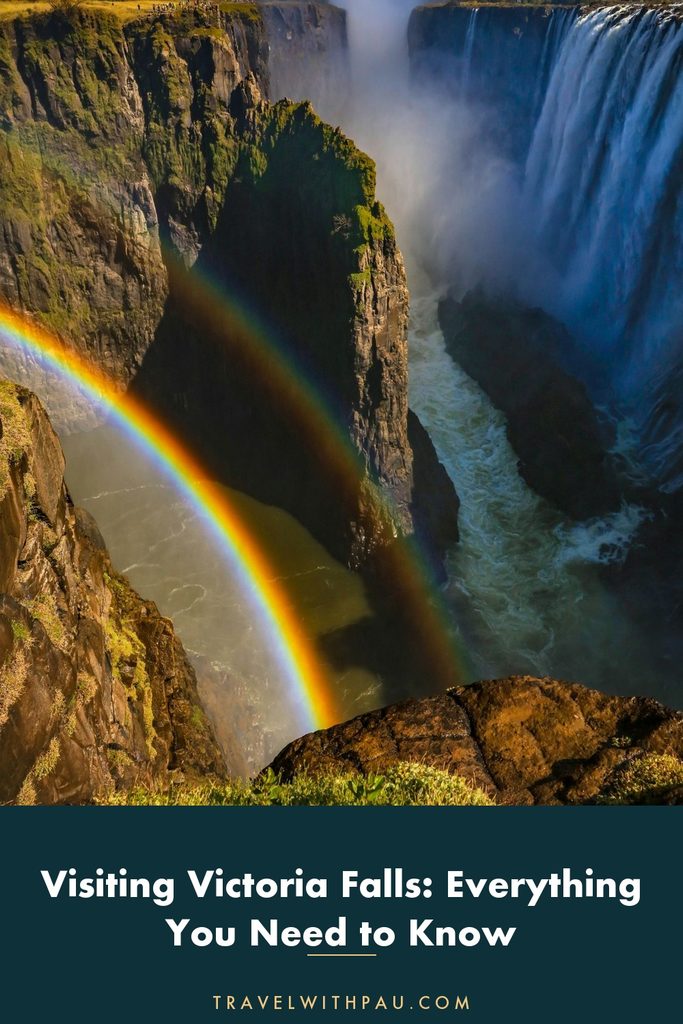
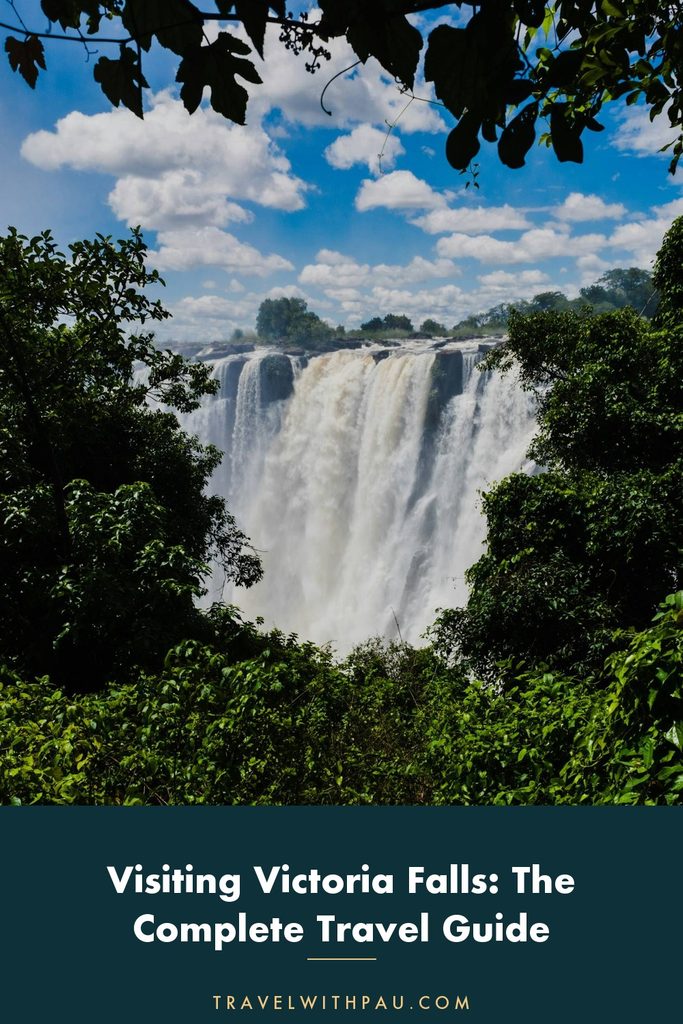
Victoria Falls is one of those places you see in photos and think, “yes, but it’s probably not actually like that.” It is. It’s exactly like that, and then some. The Zambezi River drops over a cliff edge that’s nearly 2km wide, and the roar, the spray, the rainbows, it genuinely makes you feel small in the best possible way. Trust me, you don’t want to die without experiencing this. Here’s everything you need to know about visiting Victoria Falls.
Visiting Victoria Falls: Everything You Need to Know
Victoria Falls was ‘discovered’ by the outside world in 1855, when British explorer and missionary David Livingstone became the first European to see it, writing in his diary that the sight “must have been gazed upon by angels in their flight.” He renamed it after Queen Victoria, though the name that mattered long before he ever arrived was already in use: the local Tonga people call it Mosi-oa-Tunya, “the smoke that thunders”, a name that makes complete sense the moment you’re standing in the spray.
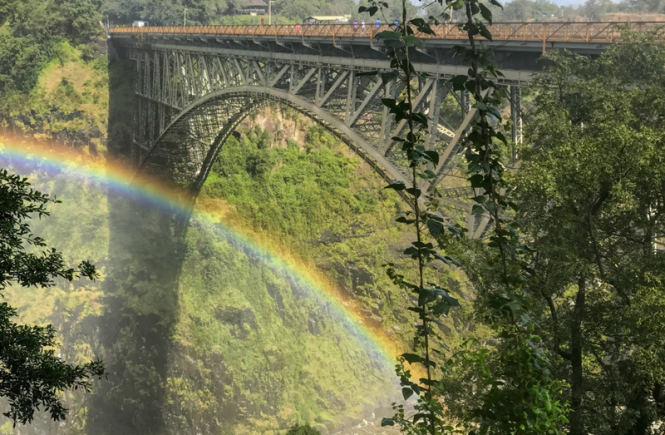
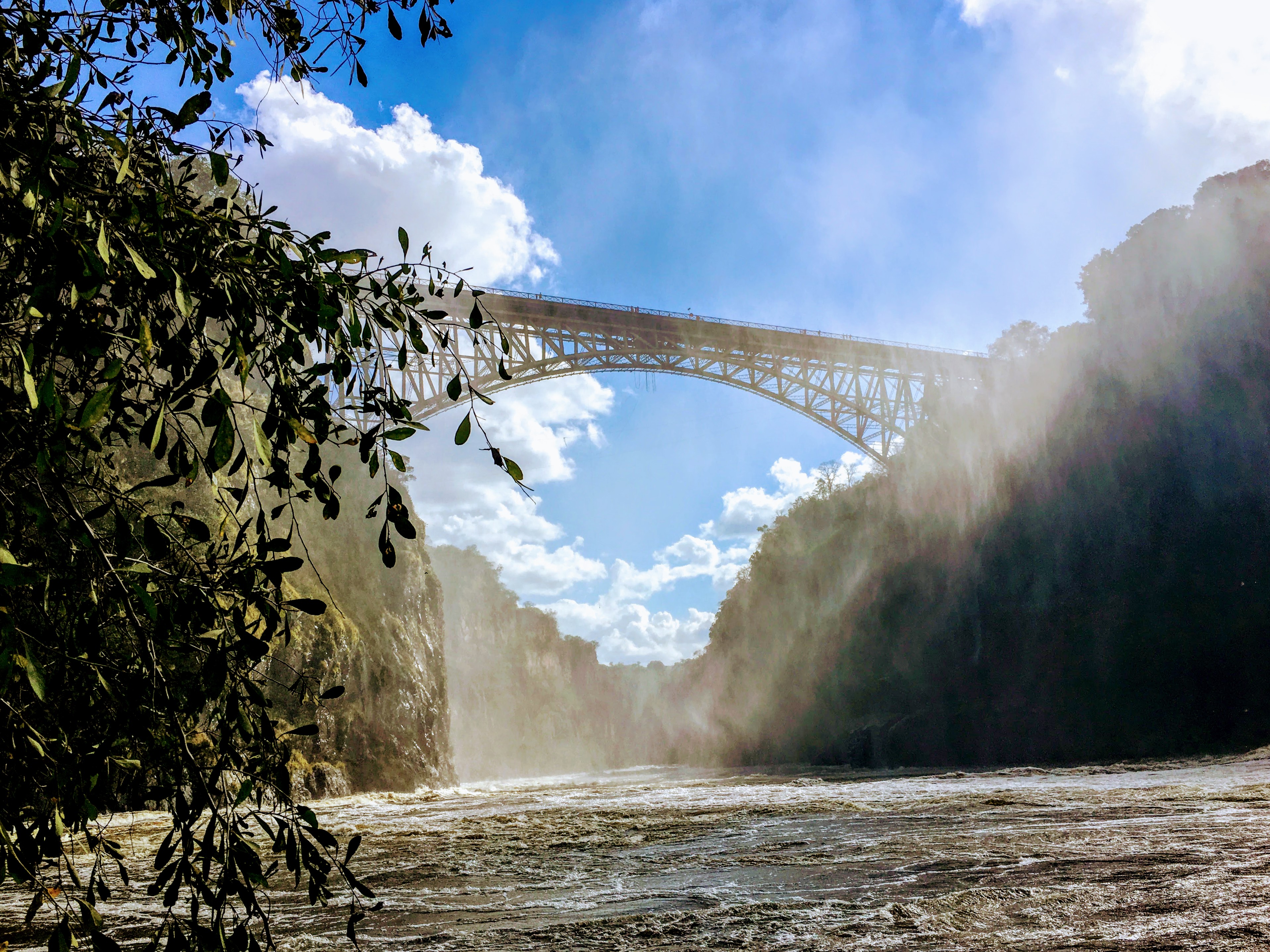
The Tonga also believe the Zambezi is home to Nyami-nyami, a river spirit, part serpent, part fish, said to control the river’s floods and the fortunes of the people who live along it. When the Kariba Dam was built downstream in the 1950s, locals blamed a string of construction disasters and floods on his fury at being separated from his wife on the other side of the dam wall. It’s the kind of story that sticks with you once you’ve heard it, standing on that bridge over the gorge.
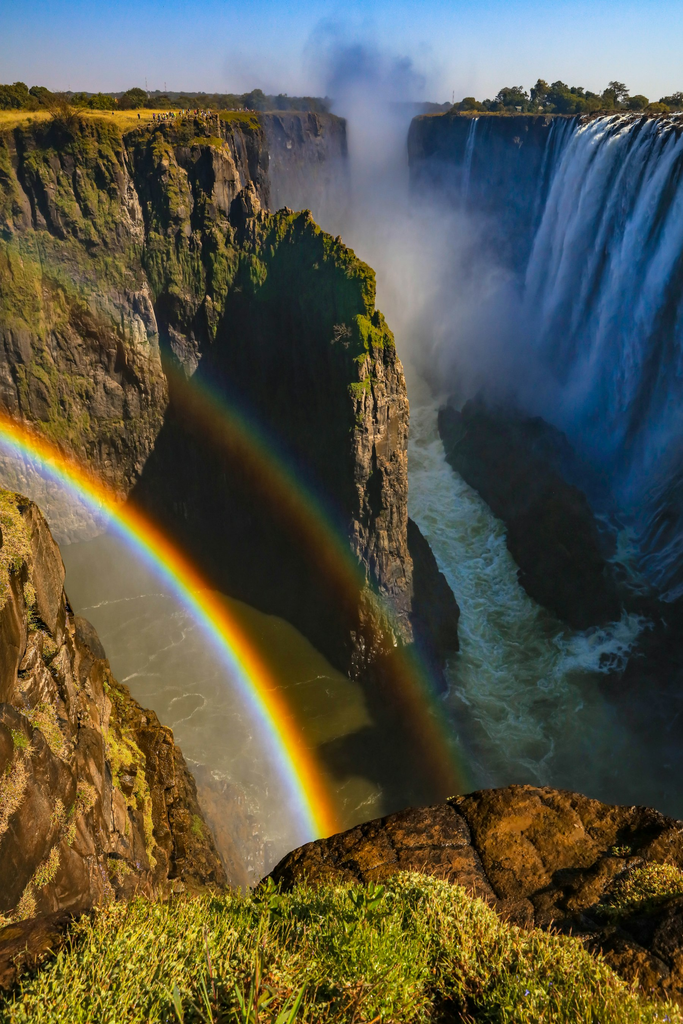
For the record: Victoria Falls isn’t the tallest or the widest waterfall in the world, but it holds the record for the largest single sheet of falling water on the planet, roughly double the height of Niagara Falls.
VICTORIA FALLS ESSENTIALS
✈️ Getting There / Victoria Falls town in Zimbabwe has its own airport (VFA), as does Livingstone in Zambia (LVI). Book a private airport transfer with WelcomePickups, it’s only a few kilometres to the falls from either town, but a fixed-price meet-and-greet beats negotiating with airport touts when you’ve just landed. Search for international flights on Skyscanner.
🎟️ Tours / The activities at Victoria Falls range from sublime to ridiculous (in the best possible way). Book the most popular ones in advance, they do sell out:
– Victoria Falls Zimbabwe National Park Entry + Tour
– Devil’s Pool at the Edge of Victoria Falls (Zambia)
– Victoria Falls Bungee Jump from the Bridge
– White Water Rafting on the Zambezi
– Zambezi Sunset Cruise with Drinks
– Flight of Angels Helicopter over the Falls
– Chobe National Park Day Trip with Lunch
Browse all Victoria Falls tours and activities
🏨 Stay / Victoria Falls town (Zimbabwe side) is my recommendation for a base, it’s quiet, walkable, and close to everything:
– Budget: Joyful Vista Guest Lodge
– Mid-range: Shoestrings Backpackers & Budget Lodge
– Splurge: Victoria Falls Hotel
📱 Connect / Worth knowing before you land: Zimbabwe isn’t covered by any regional African eSIM plan, so if you’re staying in Victoria Falls town, pick up a local Econet SIM instead, they’re cheap and widely available at the airport or in town. If you’re crossing over to the Zambia side too, I use Holafly there, use code TRAVELWITHPAU for 5% off, it works well on that side of the border, just not the Zimbabwean one.
🛡️ Get Insured / With activities like bungee jumping, white water rafting, and helicopter flights on offer, travel insurance is non-negotiable here. World Nomads covers adventure activities and is what I use every trip.
Zimbabwe vs Zambia: Which Side Should You Visit?
You can visit from both countries, and I’d recommend doing and staying in both if you have the time.
Zimbabwe side is generally considered to give better overall views of the falls, more of the main curtain is visible from the pathway, and the walk through Mosi-oa-Tunya park on the Zimbabwe side is excellent. The town of Victoria Falls is more tourist-friendly, with more accommodation options, restaurants, and activity operators. This is where I stayed and I’d recommend it as your base.
Zambia side is where you access Livingstone Island and the Devil’s Pool (dry season only), this alone makes it worth crossing for a day. The Zambia side is also better for views of the Eastern Cataract. The town of Livingstone is slightly less polished than Victoria Falls town but has a good backpacker scene.
Practical info for crossing: The two sides are connected by the Victoria Falls Bridge, which includes an immigration post. You’ll need to pay entry fees on each side (around US$20–30 per person per park) and most nationalities will need a visa for both Zimbabwe and Zambia, a KAZA UNIVISA covers both countries and is the easiest option (around US$50). You can get it on arrival at Victoria Falls Airport or the border, or apply online in advance at evisa.gov.zw to skip the queue. Always check current visa requirements for your nationality before you travel.
Allow about 30 minutes for the crossing, including immigration.
Things to Do at Victoria Falls
1. Visit the Falls Themselves: Zimbabwe Side
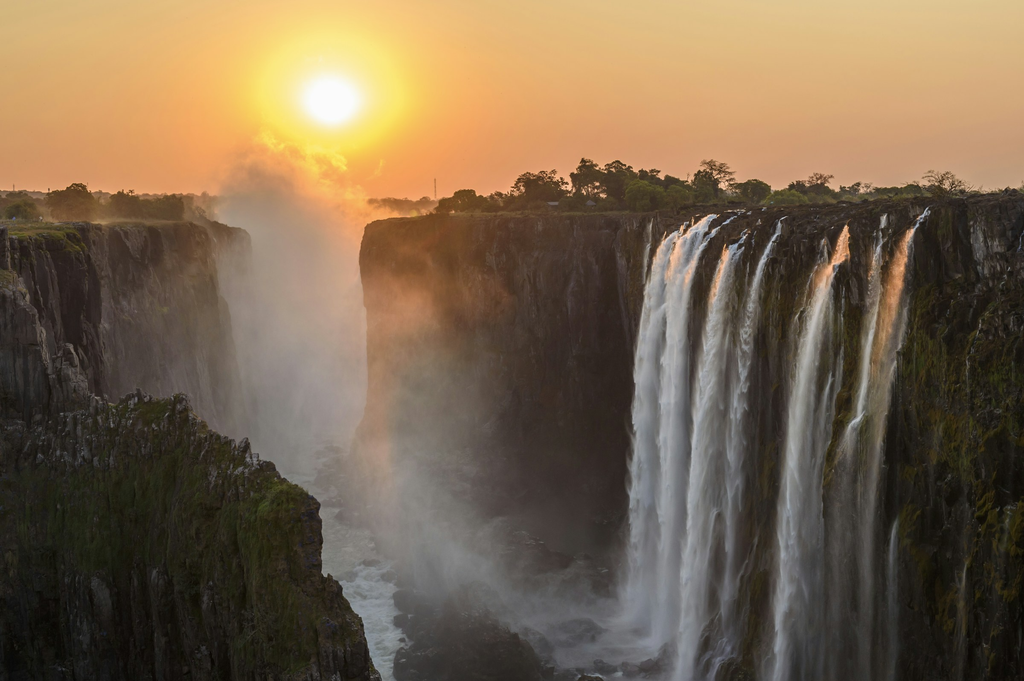
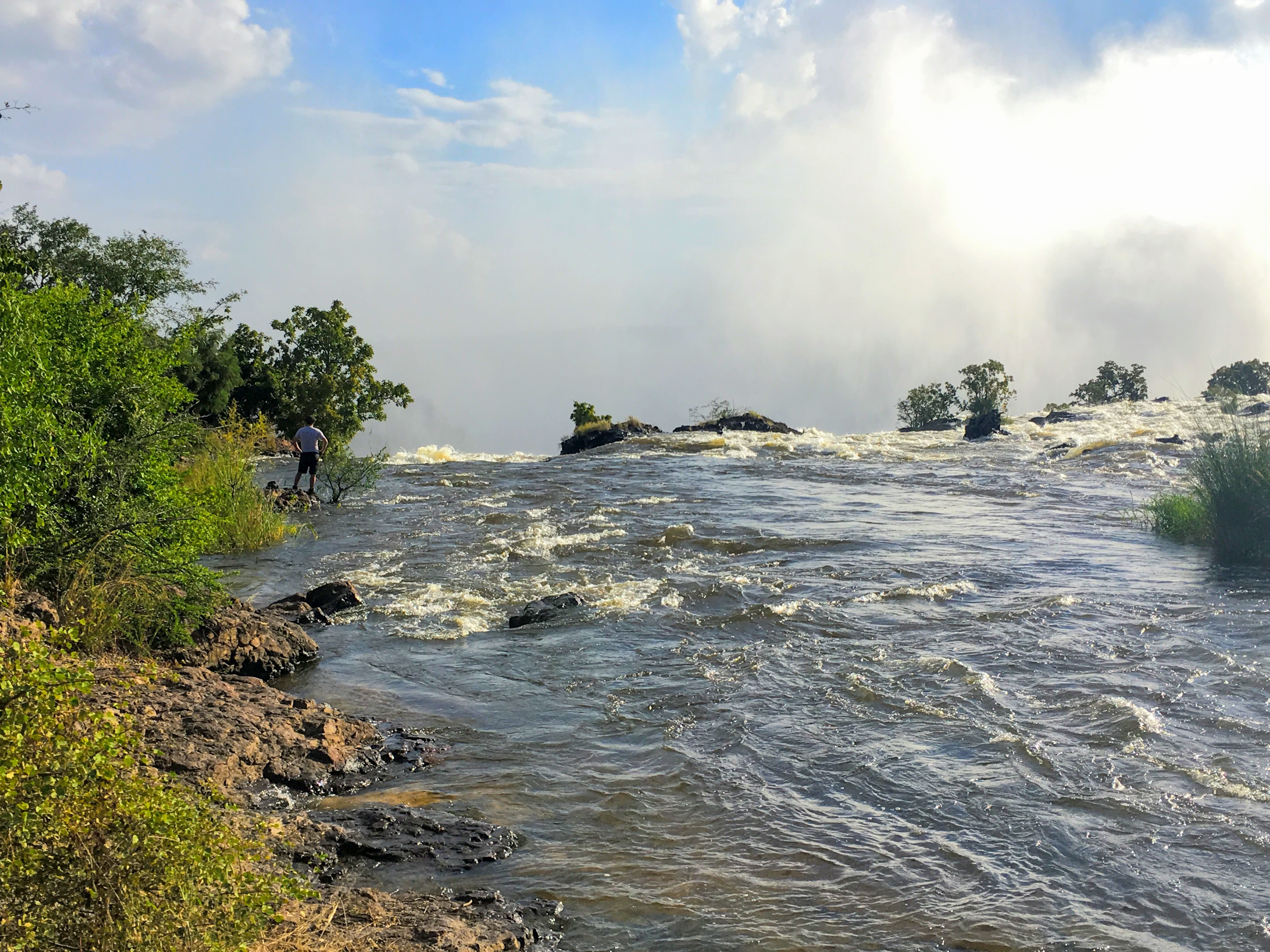
The Zimbabwe side of Mosi-oa-Tunya National Park gives you the best overall perspective on the falls. A pathway runs along the top of the gorge with a series of viewing points, some closer, some more panoramic, each one revealing a different angle on the spectacle. Bring a waterproof jacket and a dry bag for your phone: you will get soaked, even on a dry day. In wet season, expect to be completely drenched within minutes. I was completely soaked from head to toe, the equivalent of being under water.
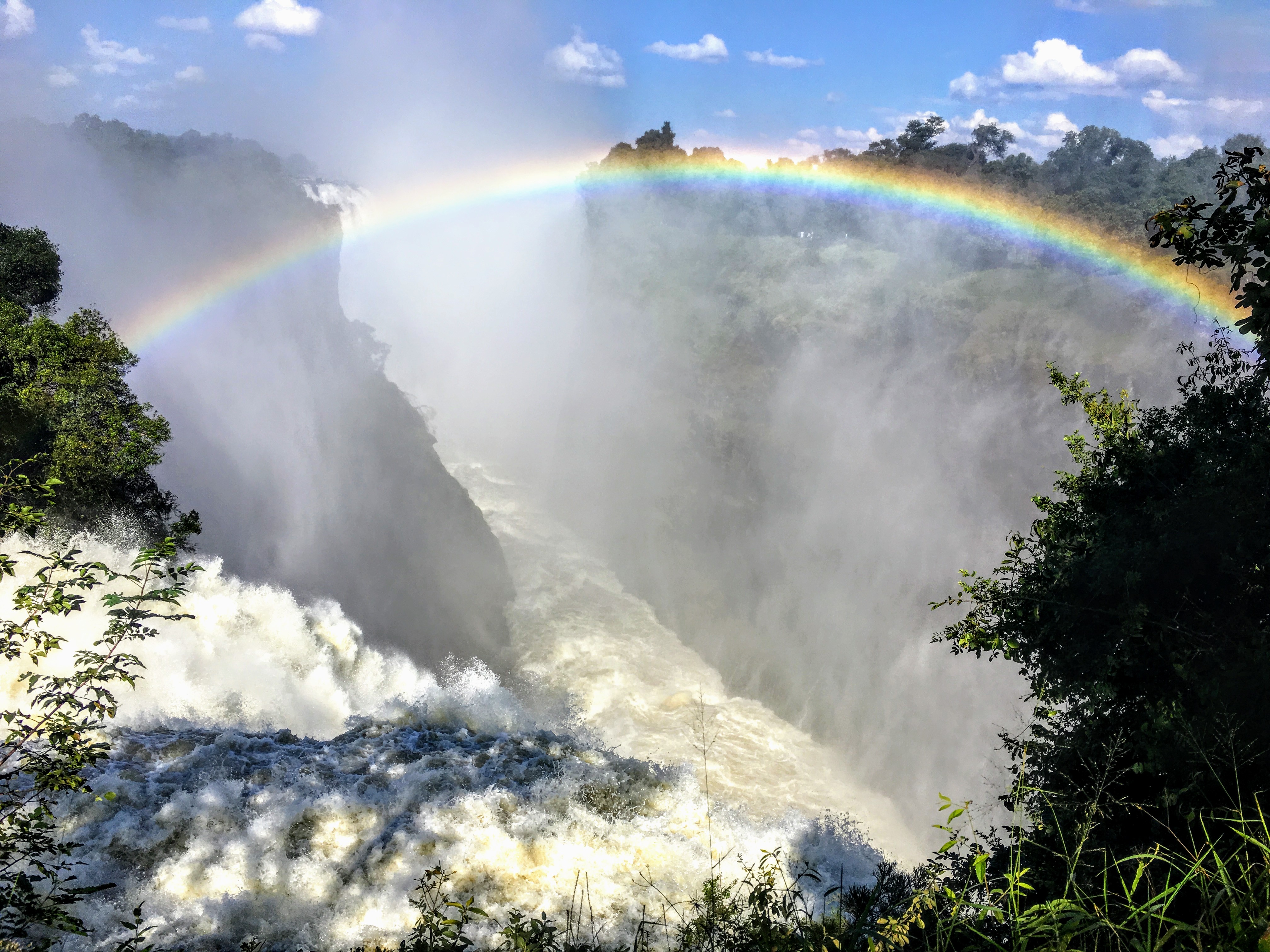
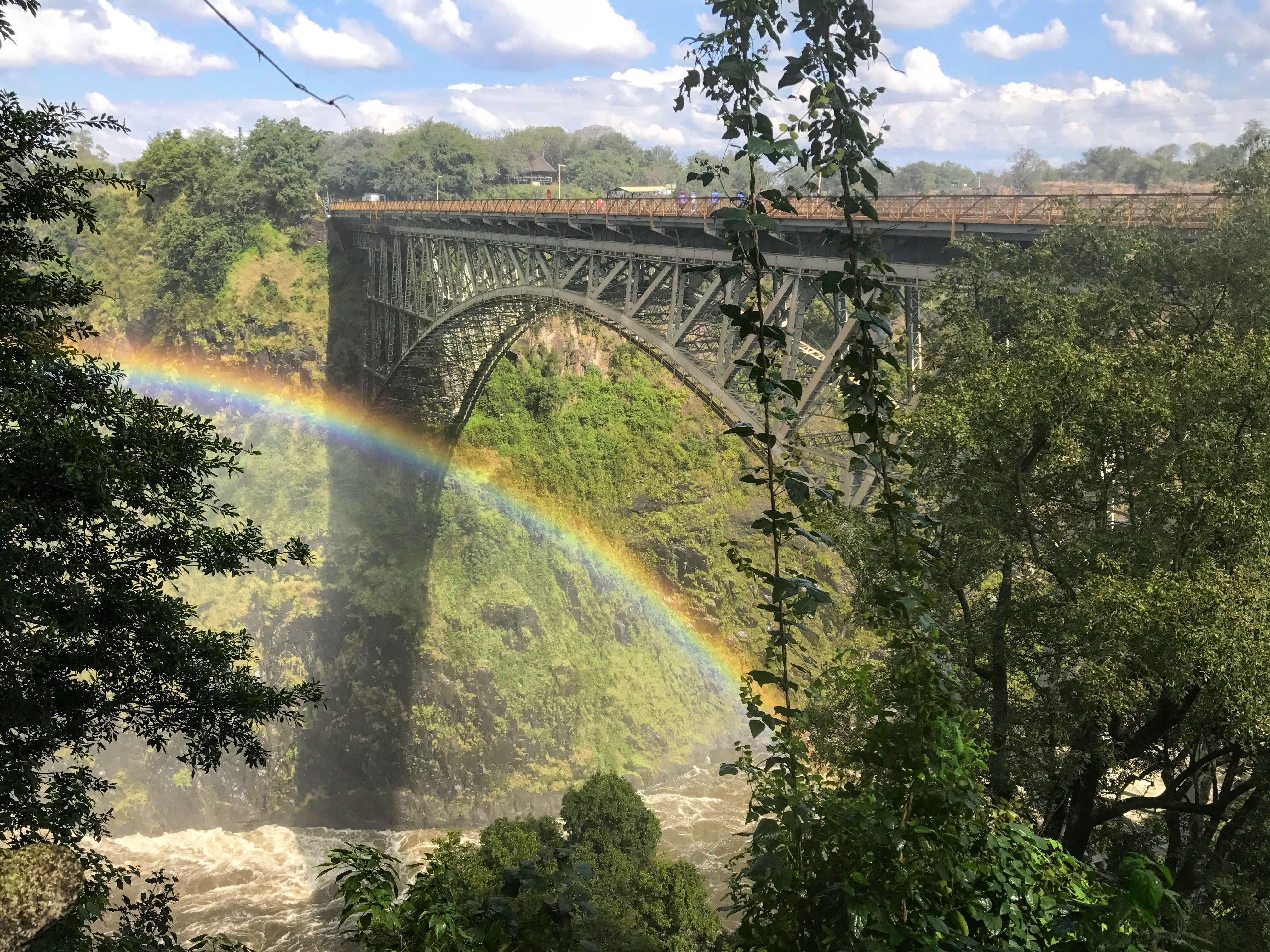
The rainbows here are some of the most beautiful I’ve ever seen, arc after arc forming in the permanent mist above the gorge. On full moon nights, a lunar rainbow appears. Book a Victoria Falls Zimbabwe National Park guided tour for the full historical and ecological context.
2. Swim in the Devil’s Pool (Zambia, Dry Season Only)
The Devil’s Pool is a natural rock pool right at the edge of the falls, and when water levels are low enough (roughly August to January), you can swim in it. You’re lying in this pool with the full width of Victoria Falls dropping away just centimetres beyond the lip of rock. It’s genuinely terrifying and genuinely extraordinary.
Access is via Livingstone Island on the Zambia side. You must go with an authorised operator, this is not something to attempt independently. Tours run several times a day with a breakfast, lunch, or high-tea package included, prices vary by option but expect somewhere in the region of $110-$200pp. If you can, book the breakfast slot, the sun is high enough by mid-morning to give you the best chance of a rainbow while you’re actually in the pool. Book Devil’s Pool in advance as spaces are extremely limited and it sells out weeks ahead. If Devil’s Pool is full or the water’s too high, ask about Angel’s Armchair, a similar edge-of-the-falls pool nearby that opens when Devil’s Pool doesn’t, a good backup rather than a lesser experience.
3. Bungee Jump off the Victoria Falls Bridge
The Victoria Falls Bridge spans the gorge between Zimbabwe and Zambia, 111 metres above the Zambezi River, and you can jump off it. The bungee jump here is one of the most iconic in the world, and it’s been on many a bucket list for good reason. You leap from the middle of the bridge with both countries in view and the gorge and river below. Absolutely wild.
Book the Victoria Falls Bridge bungee jump and tick off one of Africa’s great adventure experiences.
4. Zip Line and Gorge Swing
If bungee jumping sounds a step too far, the zip line and gorge swing offer a slightly less terrifying way to experience the drama of the gorge. The zip line runs across the gorge; the swing sends you pendulum-style into it. Both are operated from the Zambia side near the bridge. Excellent fun and the views are spectacular.
Book the Victoria Falls Bridge zip line in advance to guarantee your slot.
5. White Water Rafting on the Zambezi
Below the falls, the Zambezi churns through a dramatic gorge and produces some of the best white water rafting in the world, consistently rated among the top five rafting destinations on the planet. The rapids (particularly on the Zimbabwe side) are Grade 4 and 5, proper, terrifying, brilliant. Half-day and full-day trips are available from both sides.
This one’s seasonal too: rafting on certain sections is not possible in peak wet season when water levels are too high. Book Zambezi white water rafting here.
6. Take a Sunset Cruise on the Zambezi
For something more relaxed, a sunset cruise on the Zambezi is one of the loveliest ways to spend an evening here. You drift upstream from Victoria Falls town on a flat-bottomed boat with drinks in hand, watching hippos, elephants, crocodiles, and various birds on the banks as the sun goes down over the river. The light at sunset is extraordinary.
Dinner and drinks are typically included. Book a Zambezi sunset cruise here.
7. Fly Over the Falls: The Flight of Angels
Seeing Victoria Falls from a helicopter is genuinely one of the most spectacular things you can do in Africa. The “Flight of Angels” gives you a bird’s-eye view of the full width of the falls, the gorge, and the Zambezi winding away in both directions, scale and perspective that you simply cannot get from the ground. Yes, it’s expensive. Yes, it’s worth it.
Book the Flight of Angels helicopter tour.
8. Soar Over the Falls in a Microlight
If the helicopter feels a bit too enclosed, a microlight flight is the more exposed, more thrilling alternative, open-air, strapped in behind the pilot, nothing between you and the view. Flights depart from the Zambian side and run 15 or 30 minutes, circling the falls and the Zambezi, with a good chance of spotting wildlife in Mosi-oa-Tunya National Park below. Prices start from around $190 for the shorter flight. Book a scenic microlight flight over Victoria Falls.
9. Game Drive in Zambezi National Park
Immediately upstream of the falls on the Zimbabwe side, Zambezi National Park is a proper game reserve with elephant, buffalo, giraffe, zebra, sable antelope, and lion, all within a few kilometres of town. A morning or afternoon game drive here is extremely easy to organise (most hotels can book one for you) and can be combined with a visit to the falls on the same day.
Book a Zambezi National Park game drive for a guided 3-hour small-group drive with hotel pickup included.
For a more ambitious wildlife experience, Chobe National Park in Botswana is just over an hour away and is one of the best game-viewing destinations in Africa, particularly famous for its extraordinary elephant population. Day trips and overnight safaris to Chobe from Victoria Falls are easy to arrange, book a full-day Chobe safari with lunch and a river cruise if you want it sorted for you.
10. Visit the Local Markets
Victoria Falls town has several craft markets worth exploring, Elephant’s Walk is particularly charming, with local artisans selling wood carvings, stone sculptures, woven baskets, and colourful fabrics. You’ll find far more interesting things here than in airport souvenir shops, and the prices are negotiable. Allow a couple of hours and don’t be in a rush.
11. Sunrise Walk to the Falls
Get up early, genuinely early, and walk to the falls as the sun is coming up. The light is extraordinary, the spray catches the early morning colour, and the crowds haven’t arrived yet. On my walk one morning, I rounded a corner two blocks from town and found a herd of elephants feeding on the vegetation along the road. The locals seemed pretty impressed too, apparently this doesn’t happen every day. But it speaks to how close the wildlife is to the town here.
12. The Boma Dinner and Drum Show
For a proper cultural evening, The Boma on the Victoria Falls Safari Lodge estate is a four-course feast (a shared platter, campfire soup, a barbecue buffet with game meats, and dessert) alongside traditional dancing, storytelling, face painting and interactive drumming, you’ll be dressed in a chitenge on arrival and drawn into the show rather than just watching it. It’s touristy, deliberately so, and genuinely good fun for it. Prices run from around $45 to $60 per person, drinks not included. Book The Boma Dinner and Drum Show.
13. Dinner on the Royal Livingstone Express
For something completely different, board the Royal Livingstone Express, a beautifully restored 1920s steam train that departs from Livingstone in the late afternoon for a 5-course dinner as you rattle through the bush in elegant, linen-and-crystal dining cars. The train stops in the middle of the Victoria Falls Bridge as the sun goes down, a genuinely unforgettable photo opportunity, before you continue on to a guided tour of the bridge itself. It’s not cheap (around $399 per person), but it’s exactly the kind of splurge experience worth having once.
Book the Royal Livingstone Express dinner train.
Where to Eat in Victoria Falls
Honestly, just go to The Three Monkeys every night, it’s that good. I was vegan at the time and they did me a great vegan pizza; if you’re not, there’s plenty else on offer, including a trio of wildebeest, zebra and beef that my friend is still talking about. Take a photo with the “I ❤ Vic Falls” sign while you’re there, everyone does.
For something with a view, Lookout Café perches high above Batoka Gorge, one of the best spots in town for a sundowner or a meal while you watch bungee jumpers and zip-liners across the gorge, and the menu leans into local specialities like crocodile kebabs and a Baobab cocktail. Baines Restaurant is another gorge-view option worth knowing about, more of a sit-down meal over the Zambezi if Lookout Café is booked out.
Where to Stay in Victoria Falls
I stayed on the Zimbabwe side in Victoria Falls town and would do so again without hesitation, it’s quiet, charming (in a low-key, slightly faded way), and walkable to the falls and restaurants.
Budget Accommodation
- Joyful Vista Guest Lodge: A recently renovated guesthouse with a private garden and free parking, consistently rated Superb (9.0) on Booking.com, well-located and very good value. If you’re watching the pennies but don’t want to compromise on comfort, stay here. Best for: budget travellers who don’t want to compromise on comfort.
Mid-range
- Ilala Lodge: A lovely mid-range option with a pool and a great location. Relaxed atmosphere, helpful staff, and close enough to hear the falls on a quiet night. Best for: couples and first-timers.
Splurge
- The Victoria Falls Hotel: This is the grande dame of Victoria Falls accommodation, an Edwardian colonial hotel dating from 1904, with a stunning terrace that looks straight towards the spray rising above the falls. It’s genuinely beautiful. If you’re not staying there, at the very minimum stop in for a Mojito on the terrace at sunset. Iconic. Best for: a special occasion, honeymoon, or classic Africa experience.
Search all Victoria Falls hotels
Basing yourself on the Zambia side instead? Livingstone has its own excellent options. For something special, Avani Victoria Falls Resort sits right at the entrance to the Zambian side of the falls, with zebras and giraffes roaming freely across the grounds (rated 8.1 on Booking.com). For something more relaxed and affordable, Maramba River Lodge is a lovely riverside spot with a pool and garden, and a proper taste of nature (you may well hear elephants at night) without the splurge price tag (rated 8.0).
Getting To & Around Victoria Falls
By Air: Victoria Falls has its own international airport (VFA) with direct or one-stop connections from most major hubs. Airlink, Ethiopian Airlines, Kenya Airways, South African Airways, Fastjet, and Safair all serve it, with regional connections from Johannesburg, Nairobi, and Addis Ababa. From the UK, expect one stop. Search for flights on Skyscanner.
From Zambia, fly into Livingstone Airport (LVI), served by Airlink from Johannesburg and Cape Town, plus Proflight Zambia connecting internally from Lusaka. Proflight and Ethiopian Airlines both also fly the short hop directly between Livingstone and Victoria Falls, useful if you’re planning to see both sides but base yourself on one.
By Road from Botswana: Victoria Falls is extremely close to Kasane in Botswana, a transfer between the two takes just over an hour and costs around US$35 per person. If you’re combining a safari in Chobe with the falls (which I’d highly recommend), this is an easy route to plan around.
By Bus or Train: If you’re already travelling overland in the region, Intercape Pathfinder runs buses from Harare to Victoria Falls (around 12 hours) and from Windhoek in Namibia to Livingstone, while Mazhandu connects Lusaka to Livingstone in around 5-6 hours. For something slower and considerably more scenic, Rovos Rail runs a multi-day luxury train from Pretoria in South Africa to Victoria Falls, a proper old-world adventure if you have the time and budget for it.
Getting Around: Victoria Falls town is tiny and almost everything is walkable, the falls, markets, restaurants, and activity operators are all within a few minutes on foot. For Zambezi National Park, the Zambia side, or further afield, use a local taxi or arrange transport through your hotel.
How Long to Spend at Victoria Falls
1–2 days is enough if your only goal is visiting the falls, you can comfortably see both the Zimbabwe and Zambia sides in a day and have time for a sunset cruise in the evening.
3–4 days gives you time to add activities (rafting, bungee, game drive) and explore more leisurely. This is the sweet spot for most visitors.
5–7 days makes sense if you’re combining Victoria Falls with a Chobe/Botswana safari, one of the great southern Africa combinations and very logistically straightforward. I’ve been to Chobe myself, and my honest advice is to give it more than a rushed single day if you can, it’s genuinely one of the best wildlife destinations in Africa and deserves the time. It’s also very remote out there, so I wouldn’t cheap out on where you stay or who you go with, comfort and a solid operator matter more than they would somewhere more accessible.
For the multi-day version, book the 5-Day Triple Country Safari: Zimbabwe, Zambia & Botswana, it covers all three countries with proper lodge accommodation, a sunset cruise, a guided Falls tour, a full day in Chobe, and a helicopter flight and night game drive thrown in, exactly the kind of comfort I’d point you towards for somewhere this remote. If you’d rather rough it, the 3-Day Chobe Camping Safari is a proper bush-camping alternative, basic toilets and showers, but reviewers rave about the game viewing.
Best Time to Visit Victoria Falls
This is the most important decision you’ll make for this trip, and there’s a genuine trade-off.
Wet Season (November–June), for the full force of the falls The Zambezi River is at its highest between February and April, and the falls are at their most spectacular, the sheer volume of water is staggering. At peak wet season, so much spray is generated that you can barely see the falls themselves; you’re just standing in what feels like the heaviest rain of your life, grinning. This is when the Zimbabwe side is the better viewpoint, as the mist makes the Zambia side harder to see from. The downside: the Devil’s Pool is closed (too dangerous), and your camera and phone will struggle.
I visited in the wet season and while my GoPro was mostly useless, the experience of standing on that bridge with water running past my feet and the full force of the falls just metres away was something I’ll never forget.
Dry Season (August–January), for activities and the Devil’s Pool Water levels drop, the falls are less overwhelming but far more photogenic, you can actually see them clearly. The Devil’s Pool on Livingstone Island is open (roughly August to January), which is one of the most extraordinary experiences on the planet. Wildlife viewing in nearby national parks is also at its best. If you want to swim at the edge of the falls, come in the dry season.
Best Compromise: May–June or September–October May–June catches the tail end of the wet season, still impressive water levels, the mist is starting to clear, and some dry-season activities are becoming available. September–October is post-dry season: water levels rising again, good wildlife, and excellent weather.
Practical Info: Safety, Money & Health
Safety: Victoria Falls town and Livingstone are both very safe for tourists, crime against visitors is low and both places are geared towards tourism. You’ll get the usual attention from craft-market touts and curio sellers, especially around the bridge, a firm “no thank you” works fine. Keep an eye out for wildlife on the roads too, elephants and baboons wander freely around town, and baboons in particular can be cheeky around food, don’t leave anything out or in an open bag.
Money: The US dollar is the practical currency here on both sides of the border. Zimbabwe’s local currency (the ZiG) exists, but hotels, restaurants, and tour operators overwhelmingly quote and accept USD, so bring clean, small-denomination notes as change can be hard to come by. Don’t rely on ATMs for USD cash, bring what you need with you. Card payments are widely accepted at hotels and larger operators, but cash is still king for tips, markets, and smaller vendors.
Health: Victoria Falls is a malaria zone, so speak to your GP about anti-malarials before you travel (I use Malarone). Cover up in the evenings and pack a strong DEET repellent. You may also encounter tsetse flies, especially in the bush and during the rainy season, they’re drawn to dark colours like navy and black, so stick to lighter clothing where you can. Stick to bottled water throughout your trip.
Victoria Falls FAQ
Which side of Victoria Falls is better, Zimbabwe or Zambia?
For the overall falls experience, the Zimbabwe side is generally considered better, you get a broader, more comprehensive view of the falls from the walkway. But the Zambia side has Livingstone Island and the Devil’s Pool (dry season), which is extraordinary. Visit both if you can, the crossing takes about 30 minutes.
When is the best time to visit Victoria Falls?
It depends what you want. For the full volume and force of the falls, visit February to April (wet season). For the Devil’s Pool, activities, and better visibility, visit August to January (dry season). May–June and September–October are popular compromise months.
Do I need a visa for Zimbabwe and Zambia?
Most nationalities need visas for both countries. The KAZA UNIVISA (around US$50) covers both Zimbabwe and Zambia and is the most convenient option. It’s available on arrival at Victoria Falls Airport and at the border, or you can apply online in advance at evisa.gov.zw. Always check current requirements for your specific passport before travel.
Is Victoria Falls worth visiting in the wet season?
Absolutely, in fact, the wet season (February–May) shows the falls at their most powerful and awe-inspiring. Yes, you’ll get soaked. Yes, your photos might not turn out. But the experience of standing in that spray with the full force of the Zambezi pouring over the edge is something I can’t recommend highly enough. Just pack waterproof gear and a dry bag.
What else is near Victoria Falls?
Chobe National Park in Botswana is just over an hour away and is one of the greatest wildlife destinations in Africa, particularly famous for having the largest elephant population on the continent. Day trips and multi-day safaris to Chobe can be arranged easily from Victoria Falls. It’s the perfect add-on if you have a few extra days.
More on this trip: The Wildest Wilderness: Self-Drive Safari in Botswana | Planning for Self-Drive Safari in Chobe & Moremi
Travel insurance is non-negotiable here, with bungee jumps, rafting, and safaris on the itinerary, you want proper cover. World Nomads covers adventure activities and has excellent medical evacuation coverage, which matters in southern Africa.
Enjoyed this article? Support my work by buying me a latte. Otherwise, do me a great favor of leaving a comment and following me on Instagram (@travelwithpau). Feel free to say ‘Hello!’ I don’t bite. And make sure you save the article for later on Pinterest!

This post contains affiliate links. If you book through them, I earn a small commission at no extra cost to you, it helps keep this blog running. I only recommend things I’d genuinely use myself.
How I Survived A 10km Trek On The African Bush, Unprotected & Unarmed

“No, no, no, no!”
I screamed as I held my head in desperation while staring at our 4×4 completely stuck in the mud. My body trembling, my mind already flying, thinking about all the possible most tragic outcomes of this unlucky situation.
The time was around 3 to 4PM.
The location: Moremi Game Reserve, not far from the Mogogelo Hippo Pools.
Around five hours back we had woken up in the Savuti Camp in Chobe National Park and headed over to Moremi. On the gate we asked for the best areas to visit as we knew some parts could be flooded. We saw in our Tracks4Africa map that towards the South Gate there was a what seemed like waterholes, know as the Black Pools. They seemed worth checking out.
We began driving and quickly the dirt road become an almost unmarked grassy path. At some points it was hard to understand if we were actually following the road or not. We saw some zebra, but not much was around. We continued, longing to see hippos on the water. From afar, we saw what seemed like hippos and decided to get closer to them. We followed the map to get to the path that surrounded one of the pools and we saw four of them, resting in the water.

“Let’s go to the campsite now” we said.
We continued the path but noticed it was a bit muddy. We had got stuck and were rescued earlier that day so we both agreed. “Let’s turn back and go the other way”. But going straight was shorter, so we got off the car to look and try to find a dry patch. We found it, went forward and failed. We somehow ended up stuck in deep, deep mud and water.
And this is were the nightmare began
“We are stuck. Really stuck. There is no way of getting out of here without help” my boyfriend said.
“What are we going to do!!! No one is going to find us here” I screamed.
We were on the middle of freaking nowhere and it was now closer to 5 PM. No one was going to find us. As I said before, the path was barely marked. We weren’t even sure where it lead. It seemed to be marked in the map, but it was impossible to know for sure. The car was surrounded by bush. Even a few meters away, the car was already out of vision. Even someone 100m away could fail to see us.
We remembered that Hertz had included an option called “Hero” were they would rescue you from anywhere in case of emergency, by simply calling a phone number. When they pitched it to us, I quickly said: “But you don’t rent satellite phones and there won’t be any signal where we are going”. The Hertz rep responded that we could always call 999 (Emergencies) despite having no signal. He said he was sure it would work.

Lies, all lies.
We called 999 desperately, but nothing happened. I knew it all the time, but I just hoped nothing this terrible would happen.
I started digging water and mud from the wheels with the pots and pans we had on the car but I quickly realized it was useless and gave up. There was no way that the car was getting out of there without another calling pulling with a tow rope. No way.
So, we decided to pitch the tent and go to sleep as soon as the sun came down. We had enough food to eat semi-normally for two or three days, and for more if we were to ration it. Not everything was lost. We still hadn’t decided what our plan would be.
But, when we were setting up to sleep a visitor came by. It was a huge male elephant. His tusks were as gigantic as he was. He didn’t look happy to see us, he trumpeted and came directly towards our car.
“Get in the car” we both said to each other. The elephant was practically two meters from the car. I still hadn’t managed to close the door. I tried to do so as quietly as possible. Elephants can turn cars upside down with barely any effort. We were preparing for the worst, but he turned around and left.
The relief lasted two seconds and we were in no time discussing our options again.
“We will need to walk at some point” my boyfriend said.
As scary as it was, it was true. We could wait there but once food and water were gone, we would have to walk. Looking at the map, we calculated we were less than 10km on foot from the main dirt road were cars do circulate. There wouldn’t be tons but we would definitely expect to see at least one during the day. We were 20km on foot from the South Gate, where we knew help was guaranteed.
We started thinking about walking as something that would actually happen. The list of animals that could harm us was long: Elephant, Buffalo, Hippo, Lion, Leopard & Rhino… We knew that if any of them decided to attack us, we didn’t stand a chance. On one hand we were extremely scared. On the other hand, we remembered our bush walk in Kruger where the ranger, who always carried a gun, mentioned he only had to use it once, with a buffalo and that he thinks he could have avoided firing it.
We agreed that waiting at least one more entire day would be the most sensible. However, we both new that it was useless and that we would end up walking the day after anyways. So we decided to walk the next day.
I spent the worse night of my life.
The demons in my head wouldn’t let me sleep, making up a million different tragic endings to this story. I tried to get away from them but it was just useless. The variety of animal noises coming from outside which, except from the hippos, I couldn’t fully recognize didn’t help.
To make things worse, it started bucketing down outside. Rain would bring more mud and make the car more stuck. If there ever was hope of the mud drying out, it was gone.
We woke up when the sun came out. My boyfriend cooked a meal but the nerves twitching my stomach prevented me from ingest anything but water. We had to wait until 10AM which was the safest time to start walking as most dangerous animals are active at night, dawn and dusk. Leaving at 10 gave us enough time to make it to South Gate.
We took a small backpack with some water, food, phone and one wallet. We dressed as camouflaged with the bush as we could. A bread & kitchen knife on each of our hands.
And we started to walk.
Danger was close, as we saw hippos in that pool the day before. There was hippo poop and tracks everywhere. Hippos are the deadliest animals and responsible for most human deaths. This is because they are protective of their territory and if they think you are threatening to steal their pool, they won’t give you a chance.
We tried to get as far from the water as possible. We saw two hippos in the water but we had seen four the day before, so the others would need to be close. It was quite sunny and hot, so they would most likely be in the water. We could hear some hippo trumpeting so we proceeded with caution.
Once we had steered clear from the hippos, we stuck to the path, walking together sometimes holding hands in order to appear as big as possible.
We were constantly checking the tracks on the path to see what animals had been there and where they were going to. As it had rained, all tracks present were fresh. We were also constantly trying to find trees which would have decent height for us to climb up if we saw anything threatening.
We saw elephants but they were far far away so we weren’t in danger. On the next hour a few bird noises noises startled us, but we didn’t see anything other than impalas, who kept running from us. A few minutes later, we saw quite a big male wildebeest who did not take his eye off from us. Wildebeest aren’t dangerous unless they stampede. Just to be safe, we walked through as far from him as possible.
On the next hour we kept seeing lion tracks going to the same direction as we were.
We kept watching them to see if they stopped at some point, which meant they had gone into the bush and could be on our sides, but they kept going.
We had now walked more than one and a half hours and we were on the main dirt road. I could see fresh wheel tracks on the floor from what seemed to be two vehicles. We had missed them!
To be honest, the fact that nothing had happened so far had us a bit relaxed. We both realized this and kept prompting ourselves to stay alert. We were still in danger.
The walk continued. We saw giraffes on both sides of the road. Terrified from our presence, they run away. Every animal we run into and saw, was already aware of our presence and alert, even if they were miles away. Again, if something wanted to harm us, we didn’t stand a chance.
Suddenly, a rambling noise startled us.
It took a few seconds, but we could recognize it was a car. I put the knife down, breathed and waited. “We are saved!” I thought.
Our saviors were a lovely couple of Colombians who couldn’t believe their eyes when they saw us walking in the middle of the road. They made a space in their cramped 4×4 for both of us and told us we had been lucky, as they had just pass a buffalo herd. Let’s best not imagine what could have happened there!

They took us to our car which was probably 35 minutes away. Once there, they pulled it off the mud with a tow rope. It took a few tries and lots of force from their 4×4. We then drove back to South Gate and left Moremi. Later that day, what had happened hit me and anguish invaded my body. It took a few days to wipe the fear off.
How I survived? It was not because of skill.
The recently acquired knowledge on our organized safari in Kruger helped, but really, the odds were on our side. I’m disappointed with my poor planning. I should have done whatever possible to get a satellite phone. I didn’t take it seriously enough.
So if you read this and are hoping to go on a self-drive safari in Botswana soon, I hope my story has helped understand how wild things are out there. Despite this scare, I still loved and recommend the self drive experience in Botswana to all wildlings out there looking for some adventure, but I learned you really need to be prepared the hard way.
I’m really looking forward to go back, now to the Central Kalahari Game Reserve, now with a satellite phone!
I do have to say, I am also happy that I am here to tell this story.
Note from author – this article complements other articles related to self-drive in Botswana which you might also enjoy:
The Wildest Wilderness: Self-Drive Safari In Botswana

After a great time in Victoria Falls and a short transfer I arrived to Kasane. This town is right in the “Four Courners” where four countries almost meet: Botswana, Namibia, Zambia & Zimbabwe. It is also the only town in northern Botswana. The next town Maun, is more than 600km away.
Between these towns lies the wildest most beautiful wilderness with the Okavango Delta, one of the Seven Natural Wonders of Africa, as its protagonist. It all begins just a few kilometers south of Kasane in Chobe National Park, which benefits from one of the largest concentrations of wildlife in Africa. The Savuti, Linyanti and Chobe Riverfront areas within Chobe each offer different landscapes and unique game viewing. But that’s not all! The phenomenal wildlife experiences are continued in the Moremi Game Reserve.
Self-drive from Kasane to Maun
We left Kasane to soon enter Chobe National Park via the Sedudu Gate. Soon after the gate, rough and extremely sandy roads slowed us down. But we were in Chobe already!
Our itinerary was tight. We would spend our first night in the Savuti Campsite in Chobe and second night in the Third Bridge Campsite in Moremi. But you’ll soon learn things had to change.
What I’m trying to get at is: this is not for anyone. First of all, it requires an experienced and slightly fearless driver that is ok with driving a 4×4 in sand and mud. Second, it requires extreme preparation. There is basically nothing between Chobe and Maun other than very rudimentary campsites so you’ll need to pack all the food, petrol, and tools required to survive your journey.
Chobe National Park, Botswana
We battled through the sands and got to Linyanti in the afternoon. There wasn’t much daylight time left but we wanted to spot some wildlife before heading to Savuti. We saw a herd of ten plus elephants up close. They were right on the middle of the road coming back from the river.

We then headed to Savuti, and on our way found a couple of South Africans on a 4×2 stuck deep in the sand. Our attempts to tow them off all failed but luckily they had family in the camp and they came to the rescue!

The next day we woke up and slowly began our journey towards Moremi. We soon saw an Impala herd completely frozen, watching something at a distance. A leopard had probably got one of their friends. Minutes after, Savuti continued to surprise us and we saw a pack of six or seven lions crossing the road, probably looking for their rest place for the day. Their arrogance and peacefulness represent their power: they are feared and they know it.
We soon made our way for Moremi, seeing loads of wildlife on the way.


Moremi Game Reserve, Botswana
Moremi brought more widlife and obstacles. Our 4×4 got stuck in mud. Luckily, a local saved us pretty quickly and taught us how to handle the areas where you literally need to go through deep water. It was scary as hell but we did it.
In parallel, the lovely and zero customer centered people at Third Bridge sent us, due to flooding, to Kaziikini Camp which is outside Moremi and on the way to Maun. They dis not give us any other choice. This meant we would need to leave Moremi a lot earlier than expected. Hence we decided to visit the Black Pools and Mogogelo Hippo Pool which are on the way to the South Gate of the park.

While driving there we encountered and angry elephant who trumpeted loudly at us. Soon after we found a small waterhole with two elephants which seemed to be fighting inside it, together with hippos and a resting crocodile. At that moment I smiled to myself in joy: “Yep, this is what I’m here for”.

We continued our journey and noticed the road became a lot rougher. The track was almost inexistent. A bit of erosion of the soil from wheels could still be seen but the space between the wheels featured grass a meter long. It was clear that not many cars had gone through that road recently. However, we continued and at last, the hippos!

After the successful turnout, we decided to call it a day and head to Kaziikini Camp. It was a bit muddy around the pools, so we decided to take extra caution after having got stuck earlier. But we got stuck again! And this time we didn’t get out of it easily or safely. You can read the full survival story here.
Reflections on self-driving in Chobe & Moremi wilderness
I hope I was able to convey this through the post, but I’ll say it anyways: self-drive safari in Botswana is where long days of travel in dodgy terrains are rewarded with uncharted wilderness.
If you are adventurous, intrepid and passionate about wildlife in its most, well, wildest form then Botswana could be the experience of a lifetime.
Are up to the challenge? Then you can find tips for planning the trip in this post.
PLANNING FOR SELF-DRIVE SAFARI IN CHOBE & MOREMI


Planning for self-drive safari in Chobe & Moremi
If you are looking for pure wilderness then self drive safari in Botswana can be a very rewarding experience. I visited the Chobe and Moremi reserves in the Okavango Delta – for details on my visit see this post – but there are a lot more National Parks & Game Reserves to explore such as the barren Central Kalahari Game Reserve which is next on my list.
Please note, such uncharted wilderness comes with a price – you need to be prepared!
How to get there & around
There are several gates to the reserves, if you are coming from Kasane then you’ll approach Chobe National Park first. The road approaching Chobe is first a smooth concrete highway which then turns into, well, horrible sand. You need to be a confident driver to cruise these parks and in my opinion, a 4×4 is an absolute must.
You could also come from the south (for example, Maun) and in that case you will enter Moremi first and go to Chobe after.
Anyhow, you’ll need a good map. Cellphone reception is inexistent in the parks. Mobile data & wifi is pretty uncommon in northern Botswana so you’ll need to go back to basics.
You can rent a GPS with you 4×4, the best option as it includes navigation. What I did was download the Tracks4Africa Botswana map in my phone and use it with GPS. This works well. I found the map to be – although not perfect – quite accurate. The good thing as well is that it has interest points, such as campsites, attractions, fuel and loads more, which are available offline. The points have a description and GPS coordinates. They did come useful at many points during the trip.
Last, do carry a paper map just in case. I didn’t need it but you never know!
When to go and for how long
We went in April, and it’s said that the best time to go for wildlife watching is April to October. The weather was perfect, it was quite hot during the day but not unbearable, and got chillier at night but not too cold. We stayed for 3 days and 2 nights, one in Chobe and one in Moremi. Three days is a lot less than recommended, but my partner and I are the energetic type who prefer to squeeze in as much as possible even if it means driving most of the day. We also didn’t mind the driving as it’s really all you are there for!
If I had to recommend a time to go I would say at least 5 days. To be honest, the longer the better, as the chances to see animals hunting on prey or any other awesome wildlife episode will increase.

What you need
4×4: Although we did some people in 4x2s, guess what – they kept getting stuck! And I can tell you, getting stuck is not fun at all. We rented our 4×4 in Hertz Kasane and it was pretty awesome, but apparently Hertz is going to stop renting them in Kasane, so here’s an alternative. If you are coming from Maun you can use this rental instead.
Food & drink: You need to take all the food, drink and water for the days you’ll be there. You should bring 4 liters of water per person per day. Our 4×4 had a proper fridge, which most do, so keeping food chilled shouldn’t be an issue.
Extra fuel: There are no gas stations in Moremi or Chobe, which means you need to bring enough fuel for your whole safari. So bring extra fuel tanks. Some 4×4 have long range fuel tanks which house up to 140 liters which depending on your schedule may be enough. Fuel is sold in Khwai village in Moremi by the locals in their homes. However, they not always have it and it’s expensive.
Satellite phone: As I mentioned there is no signal. A satellite phone seemed like an exaggeration to me but after this happened I will never do self safari again in my life without being able to call for help. It’s also better to travel in at least two vehicles. Because this isn’t always possible, bring a satellite phone!
A dose of respect: Respect wildlife. Don’t get to close or do crazy things just for a picture. Don’t take unnecessary risks.
Full Checklist:
- A 4×4 preferably with two 4×4 modes, the second one being low speed full strength. It will come really useful in the sand.
- Enough fuel. Our 4×4 had a long range tank with 140 liters which was enough for our trip. You can bring extra cans if needed
- A roof tent to keep you safe from wildlife together with all tent gear (sleeping bags, mattress)
- Recovery tools: high-lift jack, sand ladders, full sized shovel and a tow rope
- Two full spare tires and an air compressor
- A satellite phone, GPS system or equivalent (already explained above)
- A gas stove, our 4×4 had one built in
- A fridge, our 4×4 had one built in, together with food for every meal. Just reiterating – you won’t be able to buy anything
- Four liters of water per person/per day
- First aid kit
- Head torch or lantern
- Any other camping gear you would normally bring

Where to stay
There are several campsites which you can chose from. You do need to pay and book in advance, and unfortunately they are not cheap nor customer friendly but that’s what happens when it is the only option you have. You need to book really in advance – I began booking more than 3 months before and I still didn’t get my first choice.
We stayed at Savuti in Chobe for one night and booked the second night in Third Bridge but were actually relocated to a campsite outside Moremi called Kaziikini. We actually slept one night in the wild due to an unlucky accident.
Chobe:
Savuti Campsite & Linyanti Campsite: owned by SKL Camps. Website here. Email: reservations@sklcamps.co.bw
Ihaha Campsite: owned by Kwalate Safaris. Website here. Email: kwalatesafari@gmail.com
Moremi:
Xakanaxa Campsite & South Gate Campsite: owned by Kwalate Safaris. Website here. Email: kwalatesafari@gmail.com
Third Bridge Campsite and Gcodikwe 1 Island Camp: owned by Xomae Group. Website here. Email: xomaesites@btcmail.co.bw
North Gate Campsite: owned by SKL Camps. Website here. Email: reservations@sklcamps.co.bw
Park fees
Park fees are payable in the gates so don’t worry about that in advance. Fees are valid from whenever you pay them to the next day at 11AM. Staff at the park gates are pretty useless when it comes to tips or help, so remember that you are on your own.
It’s worth it!
Don’t let the requirements scare you, just make sure you are prepared. This trip will make memories that you will never forget. If you are looking for absolute wilderness then this is the place.
Last you might also want to check out this Botswana Country Guide the lovely guys behind from Beard and Curly prepared as well.